Architectural Animation Workflow: From Masterplan to Motion or How We Built a 90-Second Campus Animation in 4 days
- Vladyslav Alyeksyenko
- Apr 14
- 6 min read

There is a very particular kind of architectural animation brief that tends to make people either overpromise or quietly disappear before even considering a structured workflow.
You get a masterplan. Maybe one decent urban reference. A few paragraphs describing the desired direction. No finished building package, no proper façade studies, no resolved landscape design, no lovingly assembled BIM model waiting for you like a gift from the heavens. Yet the expectation remains the same: make it persuasive, make it attractive, make it feel real enough that investors, architects, stakeholders, or municipal people can look at it and say, “Yes, I can see where this is going.”
That is exactly the kind of project my colleague and I recently worked on for a new commercial development. Unfortunately, due to the project still being in development, we had to censor the background and blur it to avoid recognition.
The final output was a 1 minute 30 second animation. Not a set of vague mood images. Not a collage pretending to be a film. An actual architectural animation with coherent aerials, human-eye views, mobility-focused details, hotel-area visuals, top views, and transitions that had to feel like they belonged to the same world.
And the interesting part is not only that it turned out well.
It is that it turned out well despite the fact that the input material was, frankly, pretty modest.
We had a masterplan, one strong urban reference, and a written description of the intended direction. That was the backbone. The brief itself described an empty plot of roughly 65,000 square meters, with Park 20|20 in Amsterdam used as the prototype/reference and a concept centered on an elevated green core, hospitality, cycling, and pedestrian movement. The agreed scope was 6–10 static views plus a 30–60 second animation, delivered on a compressed timeline.
Now, under a traditional workflow, this kind of assignment can get expensive fast.

Not because artists are lazy. Quite the opposite. Because if you want to produce a proper animation the old-school way, you usually need to build a lot before you even start moving a camera. You need a coherent 3D environment, resolved architecture, believable terrain, materials, planting, entourage, continuity between shots, and enough certainty about the design that your time does not get eaten alive by rework. If the project is still floating somewhere between concept and conviction, every extra hour of “figuring it out in 3D” starts becoming very real money.

That is one of the pain points architects know well, but clients often underestimate: architectural animation is not just rendering. It is decision-making disguised as production.
This project was a good example of that.
The challenge was not “how do we make a nice film?” The challenge was: how do we infer enough from limited information to create something persuasive without crossing the line into fiction? That line matters.
When an architect sends you a masterplan and a reference project, they are not asking you to freestyle your way into a completely different scheme. They are asking you to translate intent. That requires judgment. Which parts are fixed? Which are only directional? Which can be designed through visualization? Which must remain suggestive? And how do you do all of this quickly enough that the animation still makes financial sense?
This is where the workflow became interesting.


Instead of approaching the whole project as one giant conventional 3D production, we treated it more like a controlled hybrid process. The cameras, overall structure, shot logic, and planning relationships still had to be grounded. That part matters too much to abandon. But once the spatial logic was established, we used AI-assisted image generation very aggressively for refinement, iteration, and shot development.
That sentence tends to trigger two equal and opposite reactions:
One side hears “AI” and assumes the process was effortless. Press a few buttons, get a movie, go home early.
The other side hears “AI” and assumes the result must be sloppy, generic, imprecise, and probably collapsing under scrutiny the moment you zoom in.
As usual, both extremes are missing the point.
The reality is far more complex and useful.


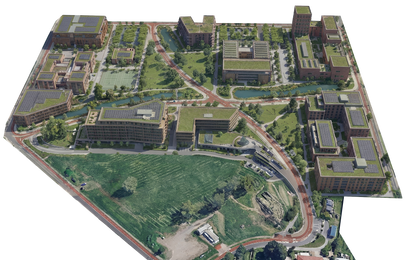

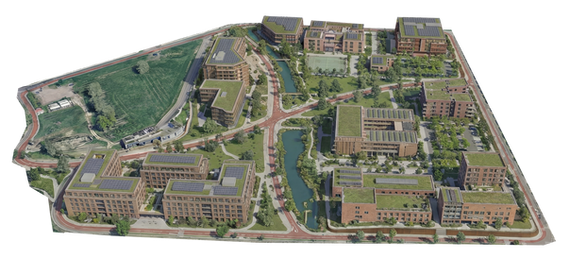
AI did not remove the need for taste, composition, architectural understanding, camera discipline, or visual consistency. What it did remove was a huge amount of friction in the middle of the process. It allowed us to iterate on design language, landscape treatment, mobility-hub detailing, hotel character, atmosphere, and realism much faster than a purely traditional route would have allowed.
That speed matters.
On my side, the project took about 30 hours. My colleague put in roughly 20. So the whole thing landed around 50 human hours for a 100-second animation built from relatively sparse source material.
For a project like this, that is fast.
At least in my view, it is comfortably at least twice as fast as the more conventional route we would have been forced into a couple of years ago. And naturally, if the time gets cut that much, the price follows the same logic. That is the bit architects and developers tend to care about most, and rightly so: not “is AI cool?” but “can this help me get a convincing result before the project becomes too expensive to visualize properly?”
In this case, yes.

But only because the workflow was handled with some restraint.
One of the easiest ways to ruin an architectural project with AI is to ask the model to become the architect, the urban designer, the renderer, the art director, and the post-production artist all at once. That usually gives you a polished lie. Beautiful perhaps, but structurally untrustworthy.
We tried very hard not to do that.
Instead, each shot had to earn its way into existence.
Aerials first, because they define the logic of the project. Then perspective shots where we could start talking about human experience: mobility hub, bike ramp, corten retaining walls, elevated gardens, hotel zone, the central public realm. Then continuity passes, because one of the silent killers of animation work is that each frame may look good on its own while the sequence as a whole feels like it was assembled from different planets.


And this is where I think the project says something useful to potential clients.
You do not always need a fully developed architectural package to justify animation.
That sentence needs nuance, so let me be careful: I am not saying documentation is optional. Better documentation still makes everything easier, cleaner, and more accurate. But there is a middle territory between “we have every detail resolved” and “we have almost nothing.” Many projects live there. Competitions live there. Early developer pitches live there. Investor presentations live there. Municipal persuasion definitely lives there.
And for that middle territory, a smarter hybrid workflow can be a serious advantage.
It lets you test the emotional and spatial potential of a project earlier.
It lets you present something more convincing than a static masterplan before the design is fully locked.
It lets architects communicate intent instead of apologizing for incompleteness.
And perhaps most importantly, it gives developers a chance to show ambition without first spending the budget similar to the yearly GDP of an island nation on a fully traditional animation pipeline.

Of course, there are limits.
I would not use this approach blindly for every project. If the brief is extremely technical, the design is legally sensitive, or the exact construction logic must be shown with high fidelity, then a more conventional 3D-heavy workflow remains the safer route. And even here, the process still relied on human supervision constantly. Prompting alone is not a workflow. It is just a lever. What matters is where you apply it, where you stop, and when you override it.
That, in my opinion, is the real dividing line in AI-assisted archviz right now.
The useful question is no longer: “Can AI make an image?”
That question is dead and buried.
The useful question is: “Can this workflow reduce time and cost without compromising the logic of the project?”
For this project, I think the answer was yes.


We started with very little. We ended with a 100-second animation that feels coherent, ambitious, and legible. The architecture reads as intentional. The public realm feels inhabited. The mobility story comes through. The campus logic is understandable. And all of that happened in a fraction of the time a more traditional route would likely have demanded.
To me, that is not a gimmick. That is a service advantage.
Architects do not need more noise around “the future of AI.” They need dependable ways to present unfinished ideas in a convincing manner.
Developers do not need philosophical debates about automation. They need visuals that help a project move forward without setting the budget on fire.
That is where this kind of workflow becomes genuinely useful.
Not as a replacement for architectural thinking, but as a multiplier for it.
If you are sitting on a masterplan, a reference project, and a brief that still feels too raw for a full conventional animation package, that does not necessarily mean you have to settle for weak presentation material. Sometimes it simply means the workflow has to be smarter.
And if this piece proved anything to me, it is that “not enough information” is no longer the wall it used to be.
Handled carefully, it can be the beginning of a very good project.
If you’re working on an early-stage development, competition entry, or investor presentation and need to translate a masterplan into persuasive visuals without committing to the full cost of a traditional animation pipeline, feel free to get in touch. This is exactly the kind of middle-ground problem I enjoy solving. Thank you for your attention!

Comments